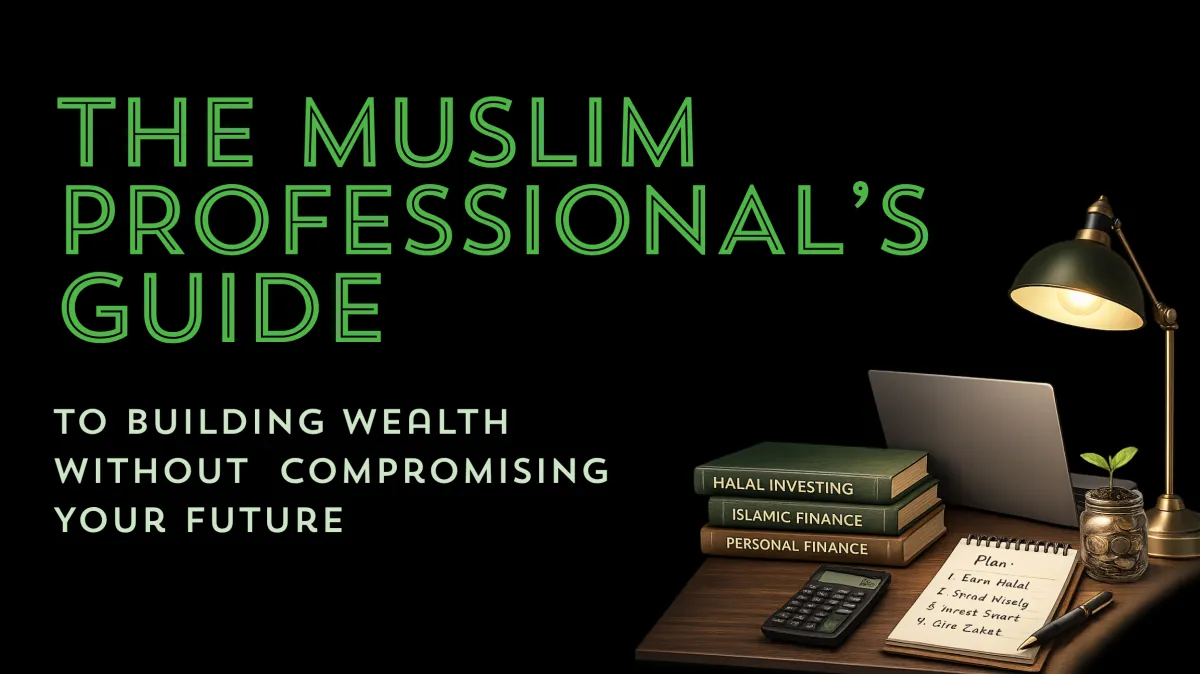
The Muslim Professional’s Guide to Building Wealth Without Compromising Your Faith
When your income grows, but your confidence in it doesn’t
You worked hard for your income. Long hours, pressure, responsibility — and finally, financial stability starts to show up in your life.
You want that wealth to grow. You want security, freedom, maybe even early financial independence.
But every time you look at conventional investment options, something doesn’t sit right.
Interest-based accounts, unclear financial products, industries you don’t want to support — and suddenly, the question becomes uncomfortable: Can I actually grow wealth without compromising my deen?
The silent tension many Muslim professionals face
This is a common struggle in Muslim professional finance today.
Most people fall into one of three patterns:
They invest anyway and ignore the discomfort
They avoid investing completely
Or they delay the decision indefinitely
The problem is, avoidance doesn’t protect wealth — it slowly limits it.
Islam does not ask you to avoid wealth. It asks you to manage it responsibly.
The 4 pillars of building halal wealth
Islamic personal finance is not only about restrictions. It’s about structure. There are four core pillars that shape halal wealth building:
1. Earn halal — your income source matters
The foundation of everything is your income. Halal wealth starts with ensuring your earnings come from permissible, ethical, and transparent work or business.
If the foundation is unclear, everything built on top becomes unstable.
2. Spend with intention — money as a form of responsibility
Spending is not separate from faith. In Islamic thinking, money is an amanah (trust).
Budgeting is not just financial management — it is discipline, clarity, and avoiding waste. The goal is not restriction, but intentional living.
3. Invest in alignment — where your money grows matters
This is where many professionals feel stuck.
Shariah compliant investments ensure your money is not growing through interest, prohibited industries, or excessive speculation. Instead, it is tied to real businesses and real economic activity.
This is the core of halal wealth building — your money should grow in a way that reflects your values.
4. Give strategically — zakat and sadaqah as part of your system
Charity is not an afterthought in Islamic finance — it is part of the system.
Zakat purifies wealth, and sadaqah strengthens community impact. When planned properly, giving becomes a consistent financial practice, not a reactive one.
Practical first steps
You don’t need to overhaul everything overnight. A structured approach works better:
Review your current accounts, savings, and investments
Identify where interest or non-compliant exposure exists
Research halal alternatives for banking and investing
Start replacing one category at a time instead of doing everything at once
Small, consistent adjustments create long-term change.
A mindset shift that changes everything
In Islam, wealth is not something to feel guilty about.
Wealth is a trust (amanah).
It is not the amount that defines success — it is how it is earned, managed, and used. That shift changes everything. It turns money from a source of stress into a structured responsibility.
Final thought
Muslim professionals today have more access to financial tools than ever before — but also more confusion.
Halal wealth building is not about limitation. It is about clarity, structure, and alignment.
At EthicaFi, we help simplify Islamic personal finance so you can move from uncertainty to a clear, practical plan for building wealth through shariah compliant investments and responsible money management.
Because growing your wealth and protecting your faith should not be in conflict — they should work together.
